There’s a quiet kind of exhaustion that hits when you do everything “right” — show up, work hard, keep learning, keep certifying, keep grinding — and the math still doesn’t work.

People are working every day, some of us for decades, and still end up juggling late bills, overdrafts, “which one can wait,” and the kind of stress that lives in your shoulders. And yes: degrees and certificates are still valuable — but they are no longer a guarantee that a full-time paycheck equals a livable life.
1) The pay vs. cost-of-living gap is real
“Just get a better job” sounds simple until you look at what a lot of essential jobs actually pay — even jobs that require training, clinical skills, and years of experience.
Around 2006, a single parent in the medical field found themselves without a home — with little kids to care for. They had done what everyone says to do: got certified, got hired, showed up every day.
The problem? The job paid about $10 an hour. It was “too much” to qualify for assistance — but nowhere near enough to cover rent, utilities, food, childcare, and transportation.
So they worked… and still fell behind.
They weren’t lazy. They weren’t reckless. They were trapped in the space where you make just enough to be denied help, but not enough to survive.
2) Rent is eating paychecks — and it’s not just “big cities”
Housing is now the single biggest pressure point for working people. Not luxury living — just a basic, safe place to sleep.
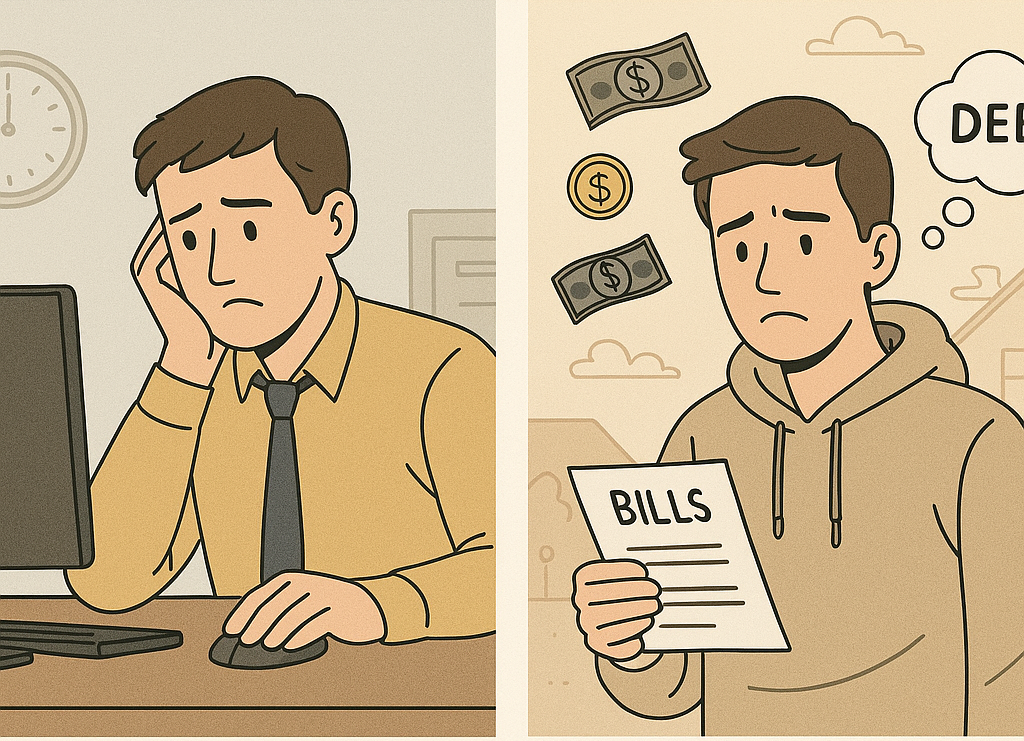
Depending on the source, national median rents often fall between the mid-$1,300s to well over $1,700 a month. But averages hide the reality on the ground. In many states and metro areas, it’s not unusual to see:
- $1,800–$2,200 for a modest one-bedroom apartment
- $2,300–$2,800+ for a small house or family-sized unit
- Application fees, security deposits, and “first & last month” just to move in
That means someone earning around $40,000–$45,000 a year — before taxes — could be spending 40–60% of their take-home pay just on rent.
The U.S. Census Bureau reported that in 2023, 49.7% of renter households were cost-burdened, meaning they spent more than 30% of their income on housing. Nearly a quarter were severely cost-burdened, paying over 50%.
When rent takes that much, everything else becomes a gamble:
- Do I delay the electric bill?
- Do I skip the doctor?
- Do I put groceries on a card again?
- Do I pray nothing breaks this month?
And if you fall behind even once, catching up can feel impossible.
3) One surprise expense can break a whole month
For millions of working families, budgets aren’t about saving — they’re about surviving until the next check.
The Federal Reserve reported that about 37% of U.S. adults would not be able to cover a $400 emergency expense fully with cash or its equivalent. That’s not a vacation. That’s:
- A car repair
- A blown tire
- An urgent care visit
- A broken appliance
- A school expense for a child
When that happens, people turn to:
- Credit cards with high interest
- Buy-now-pay-later plans
- Payday or short-term loans
- Borrowing from friends or family
And that’s how one $400 problem quietly becomes a $900 problem six months later.
It’s not poor planning — it’s math. When most of your income goes to rent, utilities, food, gas, insurance, and taxes, there’s nothing left to build a cushion.
So people walk a financial tightrope every month, hoping nothing unexpected happens.
4) Taxes can feel like “a whole day of work”
Nobody expects a paycheck to match the gross amount — but it still hits hard when you see how fast it shrinks. At the most basic level, employees pay payroll taxes for Social Security and Medicare: 6.2% + 1.45% = 7.65% (employee share), before federal income tax, and before state/local taxes.
So when someone says, “I swear taxes take a whole day’s pay,” what they’re usually describing is the combined effect of:
- Payroll tax withholding (FICA)
- Federal income tax withholding
- State/local taxes (varies by state/city)
- Health insurance premiums / retirement / garnishments, etc.
5) Student loans can follow you for years (even when life gets hard)
Student debt isn’t “just a young adult issue.” It can linger through career changes, caregiving, medical issues, and yes — even periods of homelessness.
The Federal Reserve reported that the median amount of education debt in 2024 among those with outstanding debt for their own education was between $20,000 and $24,999. And a Congressional Research Service snapshot notes the federal student loan portfolio exceeds $1.6 trillion.
6) Childcare can cost as much as rent
For working parents, the math gets even harder. You can’t work without childcare — but childcare itself can take an entire paycheck.
According to Child Care Aware of America, the average annual cost of center-based childcare for an infant in the U.S. is over $10,000–$15,000 per year, depending on the state. In many places, it’s more than the cost of in-state college tuition.
That breaks down to:
- $800–$1,200+ per month for one child
- Often much more for infants or multiple children
- Costs that must be paid whether your paycheck is good… or short
For families already stretched by rent and utilities, childcare becomes a second housing bill. Some parents are forced to work just to afford the care that allows them to work.
And if you can’t afford it? You may have to turn down hours, promotions, or jobs altogether.
7) Healthcare: you pay even when you’re insured
Healthcare is supposed to be a safety net — but for many workers, it feels more like another bill that never stops.
The Kaiser Family Foundation reported that in 2024:
- Average annual premium for employer family coverage: over $25,000
- Workers paid about $6,500+ of that out of pocket
- Average deductible for single coverage: around $1,700+
That means even with “good” insurance:
- You pay every paycheck for premiums
- You pay again before insurance really kicks in
- And you still pay co-pays, meds, labs, and surprise bills
So people delay care. Skip prescriptions. Avoid appointments. Not because they don’t care about their health — but because they can’t afford to.
So when we talk about “working hard”…
Remember that single parent in the medical field back in 2006 — working for about $10 an hour, raising little kids, making too much for help but not enough to live?
That story isn’t history. It’s still happening — just with bigger numbers.
Today, replace $10 an hour with $18, $20, even $24 an hour. Replace $700 rent with $2,000. Replace “just getting by” with “still falling behind.”
Different year. Same trap.
People are still doing everything they’re told:
- Getting degrees and certificates
- Working full-time — sometimes more than one job
- Paying taxes
- Trying to raise families and stay healthy
And yet… one illness, one layoff, one rent hike, one broken car can still send everything crashing down.
This isn’t about laziness. It’s about a system where survival costs more than full-time work provides.
If you see yourself in this — past or present — know this:
You are not broken. The math is.
And until that changes, people will keep working every day… and still wondering why it feels like they’re running in place.
So what’s the point?
The point isn’t to shame people for struggling. The point is to say out loud what too many people whisper: Working full-time should mean you can live.
If you’re exhausted, if you’re doing “enough” and it still isn’t enough — you’re not alone, and you’re not crazy. The numbers back you up. The system is expensive. And regular people are paying the price.
Sources & Citations
- Apartment List — National Rent Report (Dec 1, 2025): national median monthly rent $1,367. https://www.apartmentlist.com/research/national-rent-data
- U.S. Census Bureau press release — nearly half of renter households cost-burdened in 2023 (49.7%). https://www.census.gov/newsroom/press-releases/2024/renter-households-cost-burdened-race.html
- Federal Reserve — Economic Well-Being of U.S. Households (2024 results): share unable to cover $400 expense completely with cash/equivalent. https://www.federalreserve.gov/publications/2025-economic-well-being-of-us-households-in-2024-savings-and-investments.htm
- IRS — Social Security and Medicare withholding rates (employee share: 6.2% + 1.45%). https://www.irs.gov/taxtopics/tc751
- Federal Reserve — Higher Education and Student Loans (2024 results): median education debt between $20,000 and $24,999. https://www.federalreserve.gov/publications/2025-economic-well-being-of-us-households-in-2024-higher-education-and-student-loans.htm
- Congressional Research Service (CRS) — A Snapshot of Federal Student Loan Debt (Feb 19, 2025): portfolio exceeds $1.6T. https://www.congress.gov/crs-product/IF10158
- MIT Living Wage Calculator (updated Feb 10, 2025) — county-by-county living wage estimates and methodology. https://livingwage.mit.edu/ (Methodology: https://livingwage.mit.edu/pages/methodology)